By Irine Polyzogopoulos, Communications and Development Coordinator
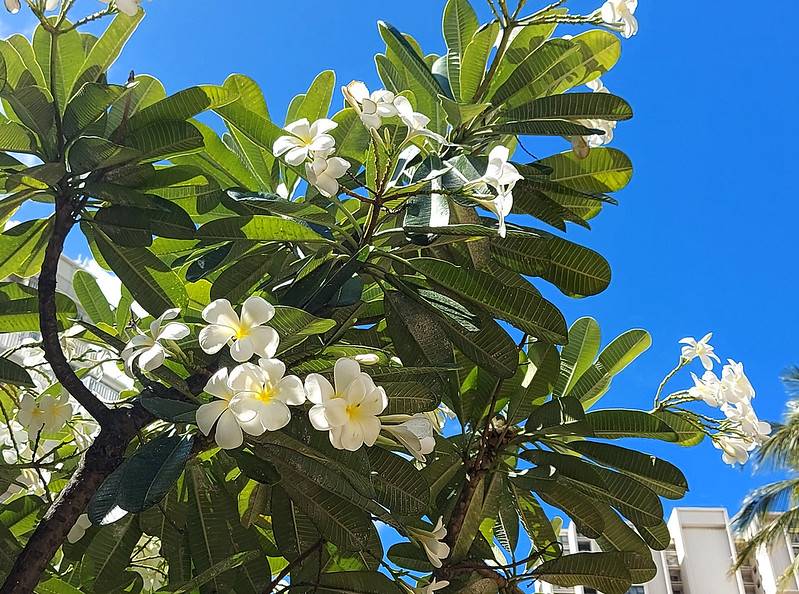
Set against a backdrop of plumerias and lush mountains, the 154th American Fisheries Society Annual Meeting charted new waters by weaving Indigenous knowledge into the meeting program for the first time.
Thanks to funding from the AAROM Innovation and Collaboration Fund, Uu-a-thluk’s fisheries biologists and communications and development coordinator attended the meeting, held from September 15-19 at the Hawai’i Convention Centre in Honolulu, Hawai’i. The event attracted approximately 1,500 participants.
“I’m very lucky that I got to attend something like this,” said Carilia Horning, Uu-a-thluk Central Region Biologist, who is Gitxsan from Gitwangak, frog clan, on her mother’s side of the family. “I am very early in my career, and one thing about that is everything I’m learning is local; the biology and relationships and connections. It was special at this time to be able to tap into what is going on globally.”
The meeting program was crafted around the theme of “Conserving Fishes and Fishing Traditions through Knowledge Co-Production.” Indigenous (and non-Indigenous) fisheries representatives from around the world shared their knowledge and research through keynote speeches, presentations, posters and casual hallway discussions.
Kānaka Maoli (Indigenous Hawaiian) keynote speakers Dr. Kawika Winter and Hi’ilei Kawelo kicked off the meeting with powerful talks that inspired five days of meaningful dialogue. Winter, a trans-disciplinary ecologist and research professor at the Hawai’i Institute of Marine Biology (University of Hawai’i at Mānoa) considers himself a “knowledge weaver” and spoke about the guiding principle, “Āina Momona.”
“Āina Momona means, literally, fat land,” he said. “What it is referring to is a state of sustainable resource abundance that can exist if you care for your islands in the right way.”
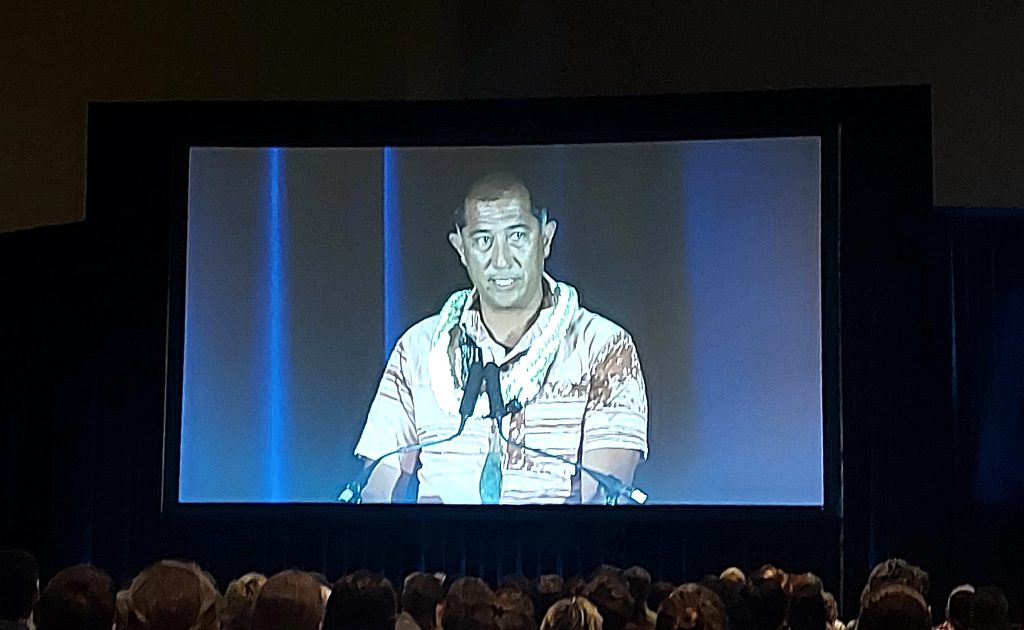
Dr. Kawika Winter captures the crowd as a keynote speaker at the 2024 AFS Annual Meeting.
Traditional Hawaiian fishponds, loko i’a, which represent Indigenous Hawaiian aquaculture dating back thousands of years, were a key focus in the plenary sessions. These fishponds have faced numerous challenges due to development, and the revitalization efforts led by Kānaka Maoli serve as an example of how Indigenous practices can help regenerate natural systems.
Kawelo, Executive Director of Paepae o He’eia, shared her work restoring He’eia fishpond, an 800-year-old aquaculture site. Her presentation celebrated grassroots community efforts and the deep connection between land, water and culture, declaring, “We give it our all because the Āina [land] deserves it.”
Uu-a-thluk’s involvement at the conference went beyond attendance. Southern Region Biologist, Huu-yiik, Sabrina Crowley, collaborated with DFO Science’s Carey Holt and Jaclyn Cleary, and Saul Milne and Candace Picco from Ha’oom Fisheries Society, to develop and sponsor the meeting session Pairing Indigenous Knowledge Systems with Western Science to Rebuild Depleted Populations.
The session, chaired by Milne, explored how Indigenous Knowledge and Western science can work together to restore fisheries and ecosystems. Lane presented on the ʔuuʔaałuk ƛusmit (Taking Care of Herring) Project and participated in two panel Q & As, while Crowley discussed aligning species-at-risk processes with Indigenous Knowledge Systems for marine fishes in Canada.
Other session speakers included knowledge holders Terry Dorward (Tla-o-qui-aht First Nation), Chief Nang Jingwas, Russ Jones (Council of the Haida Nation), Liz Allyn (Makah Tribe) and Mark Cleveland (Gitanyow Fisheries Authority).
In total, thirteen speakers shared case studies from the BC coast, the BC interior and other regions across the United States, illustrating how knowledge co-production has been applied to rebuild fish populations.
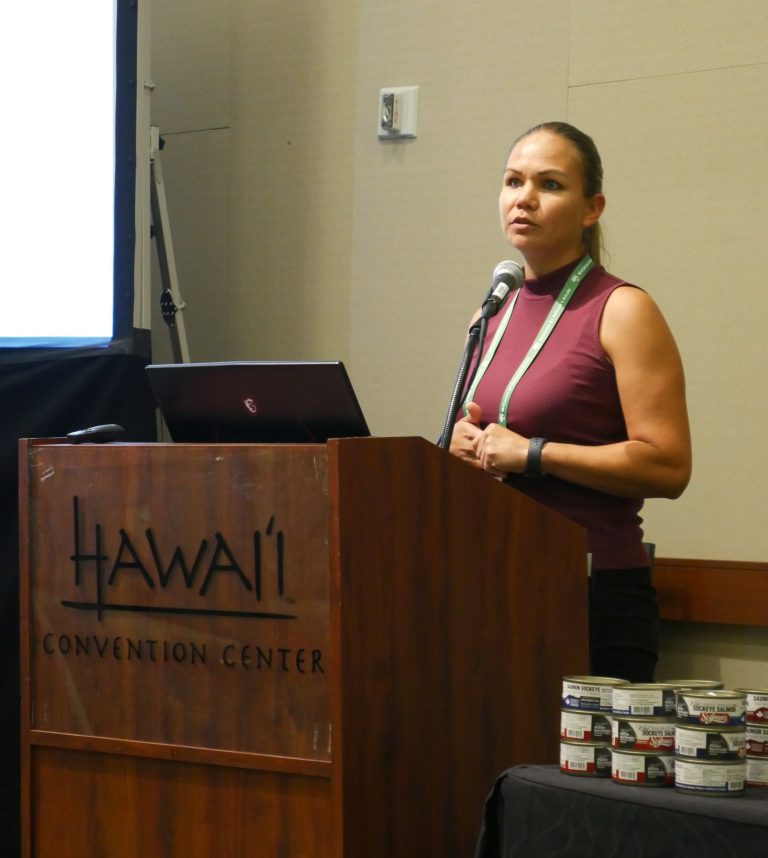
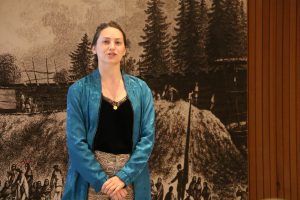
Huu-yiik, Sabrina Crowley, shares her expertise at the ‘Pairing Indigenous Knowledge Systems with Western Science to Rebuild Depleted Populations’ session.
Milne reflected on the meaningful connections forged at the conference.
“My experience was that the teachings and values of the Kānaka Maoli and the other Indigenous participants from the Pacific were similar to mine from the Salish world and those that I have been taught by the Nuu-chah-nulth,” he said.
Aidan Schubert, Marine Biologist Planner for Council of the Haida Nation (CHN), who worked with Uu-a-thluk staff on communications outreach for the Northeast Pacific Deep-Sea Exploration Project expedition in August, echoed a similar sentiment.
“It was great to learn about the work that Indigenous Peoples and organizations are doing and how some of it overlaps with CHN’s Marine Planning work, such as Maori folks working to restore eel populations in Aotearoa and Mariana Islanders working to sustain local fisheries,” he said.
While the 154th Annual Meeting was a significant step forward in incorporating Indigenous Knowledge Systems into fisheries science, there was also recognition of areas for growth.
“In the future, AFS still has some work to do when it comes to providing dedicated financial support for the participation of Indigenous Knowledge holders, Indigenous community members, and those who work in smaller community organizations,” said Milne.
Cleary pointed out that while further improvements are needed, meaningful progress has been made.
“Even for heavily quantitative sessions where knowledge coproduction was not yet apparent, there were honest discussions about the importance of advancing collaborations with Indigenous peoples and for finding ways to grow inclusion and partnership.”

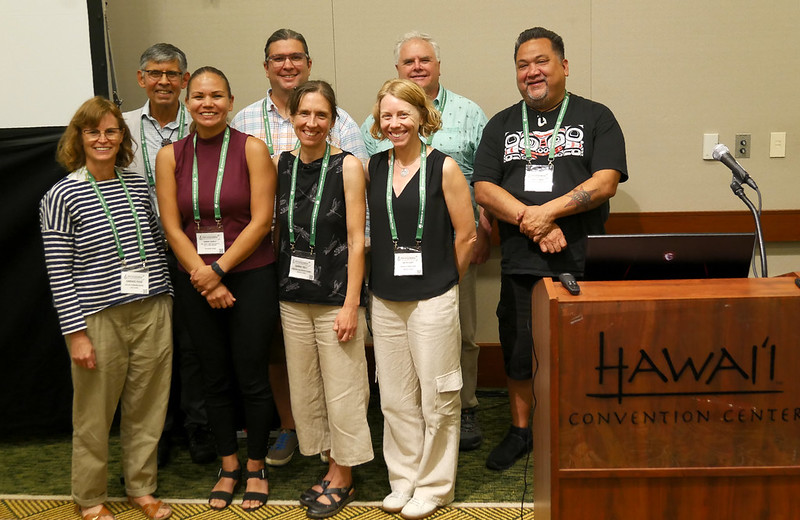
Uu-a-thluk staff members Carilia Horning (L) and Kayley Hollyer (R) tasted a variety of traditional foods and enjoyed performances at the Indigenous Networking Session.