By Dani Robertson, Northern Region Biologist
In the late 1980s, a national sampling program by the Government of Canada found that shellfish near coastal pulp and paper mills in British Columbia contained high levels of chlorinated dibenzo-p-dioxins and dibenzofurans, commonly referred to dioxins and furans.
These toxic compounds came from insufficiently treated pulp mill effluent discharged into nearby waters, where they can persist for decades, accumulating in marine food webs and posing serious risks to both aquatic life and human health through long-term exposure.
As a result, Fisheries and Oceans Canada (DFO) closed several shellfish fisheries along the BC coast, including Muchalaht Inlet, in 1990.
For many First Nations, shellfish have long been an essential food source and a cornerstone
of cultural practice. The closures were imposed without consultation, forcing nations such as
Mowachaht/Muchalaht First Nation (MMFN) to alter their traditional harvesting and diet patterns.
Later studies suggest that the health impacts of disrupting these practices could rival or exceed the risks posed by dioxin exposure. Beyond health, these closures also disrupt cultural and social well being.
When pulp mills began to close in the 1990s, DFO gradually lifted many shellfish closures. The
Gold River mill shut down permanently in 1998, and the last DFO dioxin monitoring that same year showed declining contaminant levels. Yet despite the improvement, Muchalat Inlet remains closed to the commercial crab fishery, and a non-commercial consumption advisory is still in effect.
MMFN has repeatedly called for a review and possible reopening, but no action has been taken.
Dioxins and Dungeness crab
Dioxins and furans are by-products of industrial processes and are among the most persistent and toxic chemicals known. Once released in pulp mill effluent, they attach to sediment particles that are distributed by currents and settle to the seafloor.
Bottom-dwelling species like Dungeness crab are particularly vulnerable, as they scavenge and feed in these contaminated areas.
The crab’s hepatopancreas, its main digestive
organ, tends to accumulate higher concentrations of dioxins and furans than in other species. This makes the Dungeness crab a key indicator for monitoring legacy pollution in coastal ecosystems.
A new look at an old problem
In June 2025, DFO research scientist Dr. Lisa Loseto, who specializes in marine contaminants at the Institute of Ocean Sciences in Sidney B.C., approached the Council of Ha’wiih Forum on Fisheries.
She had come across past correspondence requesting a re-examination of the Muchalat Inlet consumption advisory.
“I became curious about what current levels might look like, given nearly 30 years have passed without monitoring,” said Loseto.
With the full support of Chief Mike Maquinna and the Ha’wiih, Dr. Loseto and her team partnered with MMFN Fisheries and Uu-a-thluk staff to design a new sampling program.
“It’s something we’d like to see more of,” said Chief Maquinna, at the June Council of Ha’wiih Forum on Fisheries gathering.
“We need to know what’s there and what isn’t. There’s no certainty right now, no recent studies, and we hope that will change,” he added.
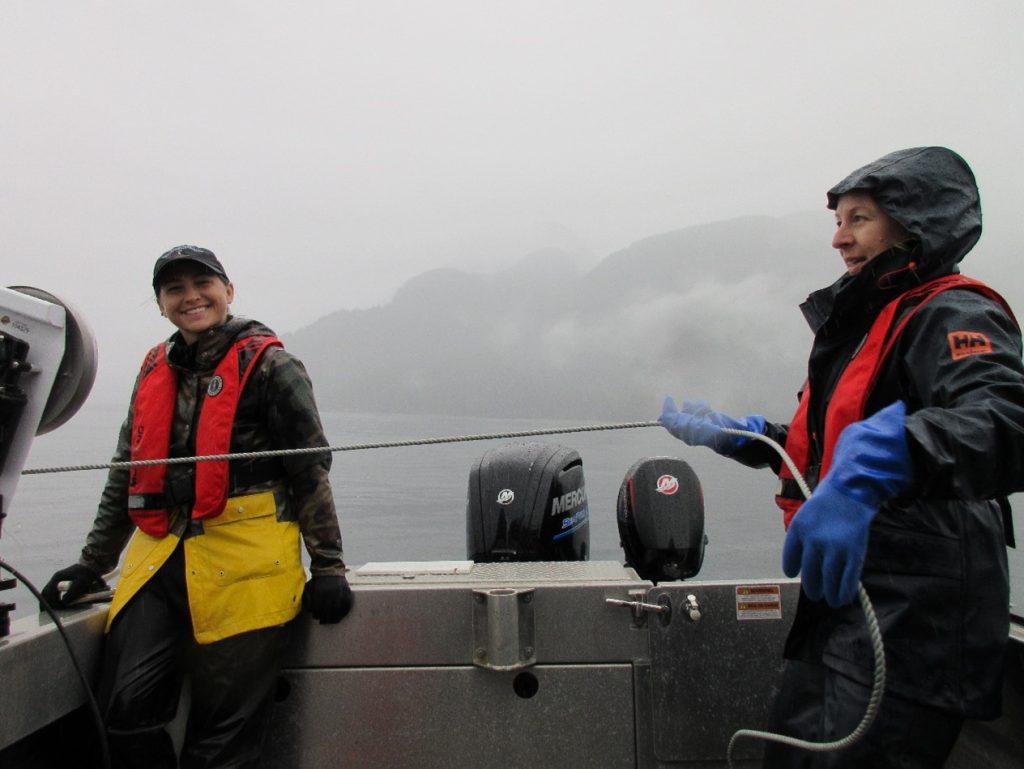
Vanessa Moll, MMFN Marine Biologist (left) and Dr. Lisa Loseto (right) pulling up a crab trap in Muchalat Inlet.
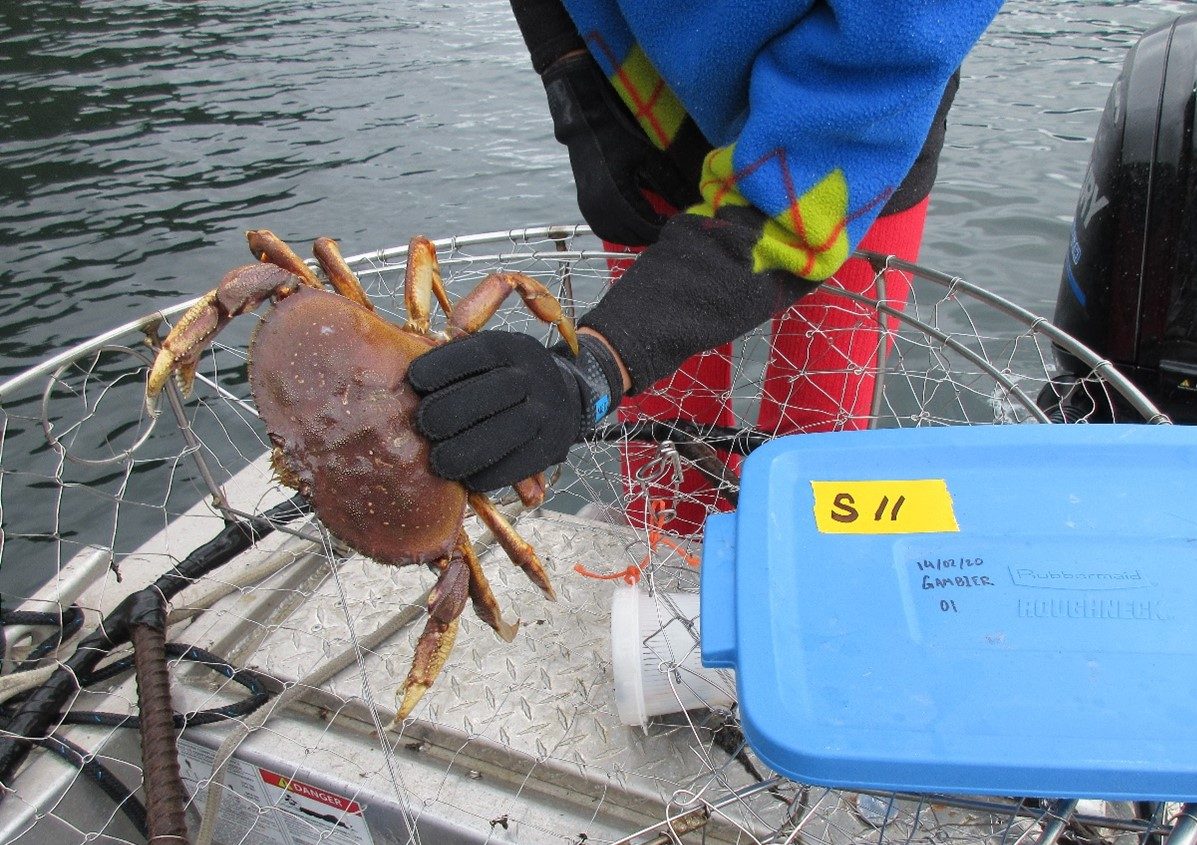
In August 2025, the joint team set out to collect Dungeness crab samples from Muchalat Inlet. The fieldwork was challenging; legal-sized male crab were hard to find, and the team caught only four.
Many undersized crab and other species, such as red rock crab, flounder, rockfish and even abalone, were encountered. Despite the small sample size, four specimens were sufficient to begin analysis, and plans are underway for additional sampling.
Winter and spring are expected to yield better results, with traps deployed at varying depths. Dr. Loseto remains optimistic.
“I didn’t realize how difficult it would be to find Dungeness crab here,” she said, “but I look forward to learning from MMFN about local conditions and improving our sampling methods.”
As testing continues, there is renewed hope that science and traditional knowledge can guide future decisions on the Muchalat Inlet closure, perhaps paving the way for the return of a vital and culturally significant food source to MMFN harvesters.