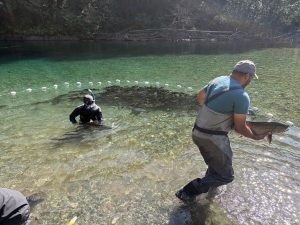
On a crisp morning in late October, fisheries staff and volunteers gathered along the Tranquil River, united by a shared goal: to help rebuild the suuḥaa (Chinook) salmon population.
The team – representing Uu-a-thluk, Ha’oom Fisheries Society, Tofino Salmon Enhancement Society (TSES) and volunteers – worked together to retrieve holding tubes containing Chinook broodstock (mature fish used for breeding) sunk at the bottom of the river the previous week.
The Tranquil River, like many Pacific streams, faces ongoing challenges from habitat loss, climate variability and human activity. Salmon enhancement programs for the river depend on artificial spawning, collecting eggs and milt (sperm) from returning adults to supplement natural reproduction.
This process increases the number of young salmon surviving the vulnerable early stages leading to increases in returning adult salmon.
More than a technical exercise, the operation was a testament to collaboration.
“Partnerships are vital because they bring together diverse groups and experts who can learn from one another, fostering capacity-building across the region,” said Whehs-Wiss-Sunup, Jared Dick, Uu-a-thluk’s Central Region Biologist.
“Beyond facilitating knowledge exchange, partnerships also allow limited regional resources to be pooled to achieve shared objectives that would be difficult to accomplish independently,” he added.
After assessing each fish for ‘ripeness,’ the team performed egg and milt takes in the forest while protecting them from the sun as ultraviolet rays can damage viability.

Uu-a-thluk’s Jared Dick extracts milt from a male suuḥaa with the support of Caralynn Bowes, a TSES volunteer.
Ten pairs of male and female suuḥaa contributed to the effort. The team carefully transported the eggs and milt to the TSES hatchery, where the fertilization and incubation of an estimated 30,000–35,000 eggs took place.
The day’s work also included a swim survey to count adult salmon returning to the Tranquil, and collection of biological samples for ongoing research and stewardship. Crew members measured fish length, collected otoliths, DNA, and scales for age.

Tofino Salmon Enhancement Society volunteers work together to remove and document an otolith sample from a female suuḥaa after her eggs are removed.
Hands-on activities like these are part of a broader strategy outlined in the West Coast Vancouver Island (WCVI) Chinook Salmon Rebuilding Plan, finalized in April.
Developed through collaboration among First Nations, Fisheries and Oceans Canada (DFO) and other organizations, the plan sets objectives for restoring Chinook populations through habitat protection, hatchery augmentation, reduced harvest pressures and genetic diversity safeguards.
“The plan includes sections highlighting Nuu-chah-nulth worldviews and perspectives on what it means for a Suuḥaa [Chinook] population to be considered rebuilt,” said Keaton McCallum, Junior Biologist with Ha’oom Fisheries Society (HFS).
McCallum added that while these sections are important, DFO has not yet fully implemented them and federal action is required to transition from resource-based management to ecosystem-based co-management consistent with the Nuu-chah-nulth principle of hišukʔiš c̓ awaak (everything is connected).

Keaton McCallum, junior biologist with Ha’oom Fisheries Society.
According to Candace Picco, Senior Biologist with HFS, the plan officially recognizes the state of WCVI suuḥaa at the federal level, but the society has recently encountered how it is simultaneously creating limitations to rebuilding Chinook.
“Some requirements to rebuild a system go against recommendations in the Rebuilding Plan,”
said Picco.
“Suuḥaa in almost all rivers in Clayoquot Sound have declined to numbers too low to collect broodstock to enhance. With a closer look at the Moyeha River, for example, even the small number of fish are primarily hatchery strays,” she added.
Salmon hold a special place in the hearts and history of the Tla-o-qui-aht First Nation (TFN), whose hahuułii (Chiefly territory) encompasses the Tranquil River. For generations, salmon have been a vital source of nourishment and central to ceremonies, feasts and cultural identity.
However, it has been over three decades without access to terminal salmon fisheries in the Tla-o-quiaht’s hahuułii, and the nation has been sounding the alarm on the need to protect and rebuild fish populations and habitats for just as long.
When asked what a rebuilt Chinook population would look like, Saya Masso, TFN’s Natural Resources Manager, explained, “…It would mean enough salmon are returning to allow surplus salmon to feed bears and trees; more than enough to cover all spawning gravel and enough to provide for our community to harvest from.”