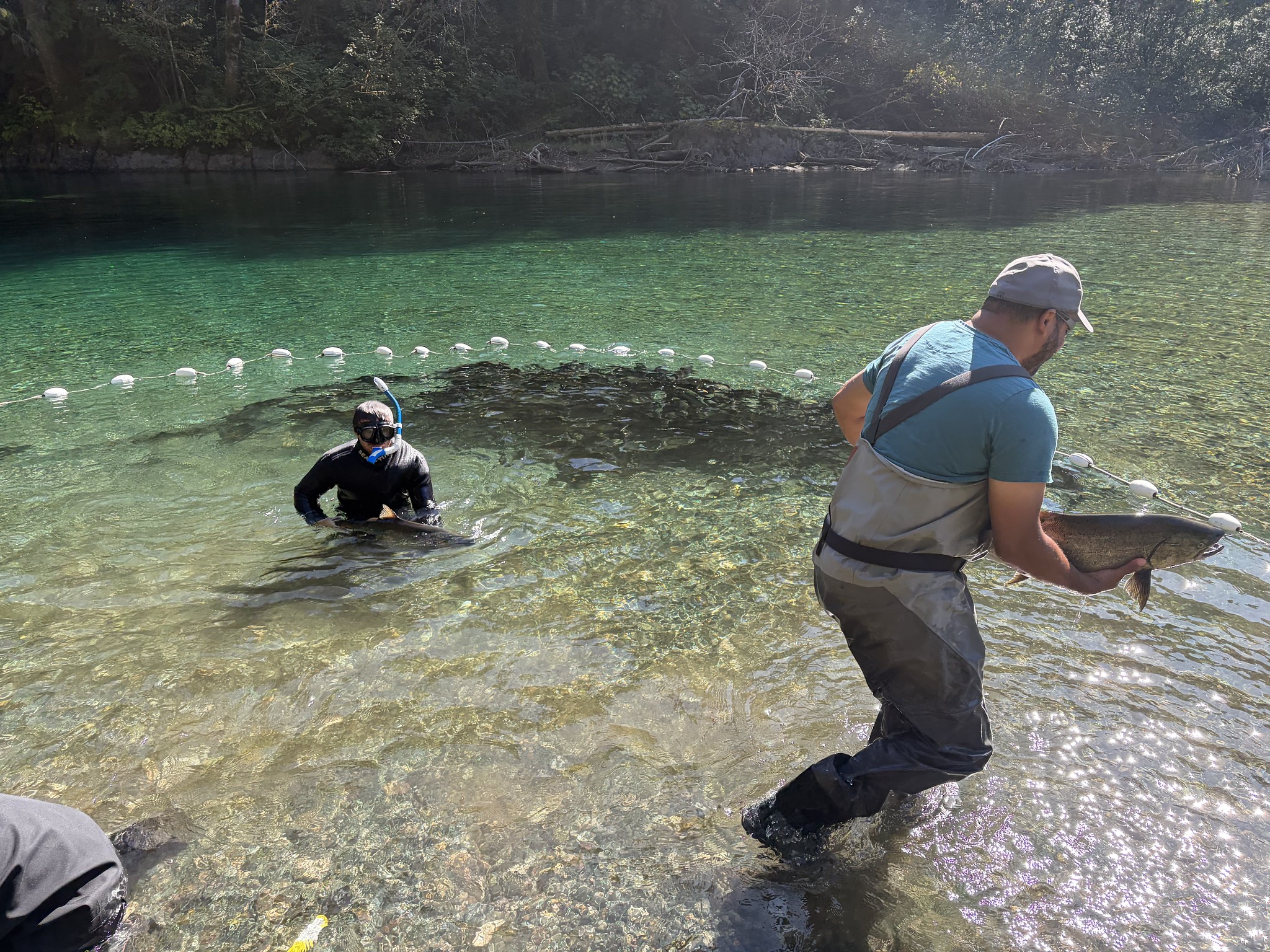
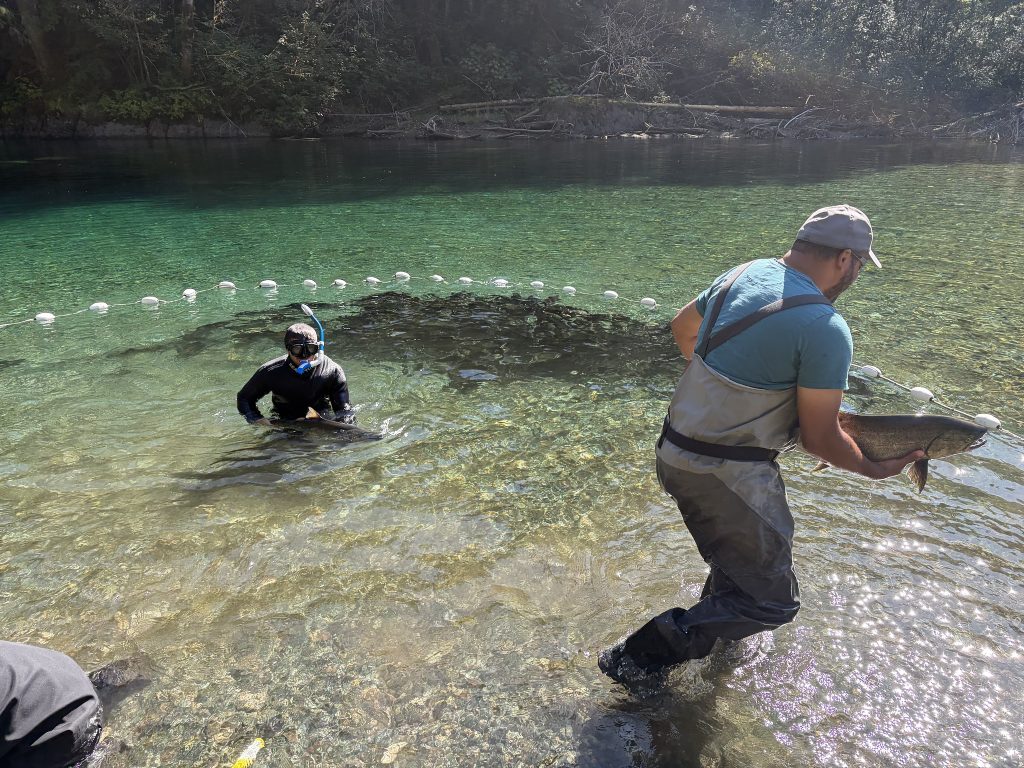
L to R Keaton McCallum (Ha’oom), Shane Johnson (LGL). Shane is releasing a sampled Chinook back into the river. Keaton carrying up the next Chinoo to be sampled. Captured school of Chinook, Chum and Coho hanging out in the net.
Nuu-chah-nulth ha-houlthees are home to three of DFO’s largest salmon hatcheries in British Columbia: Conuma Hatchery near Gold River, Robertson Creek Hatchery near Port Alberni, and Nitinat Hatchery near the Ditidaht village of Malachan at the head of Nitinat Lake. Together, these hatcheries produce approximately 14,500,000 juvenile Chinook each year. In addition, 14 smaller community-based hatcheries from Pacheedaht to Tahsis produce another 1,750,000 juvenile Chinook annually.
Although most naturally produced Chinook salmon exhibit strong homing behaviour and return as adults to their natal streams, some return to non-natal streams through a natural process known as straying. The population receiving the stray is referred to as the recipient population, while the population producing the stray is the donor population. Quantifying straying has become increasingly important because hatchery-produced Chinook generally stray at higher rates than wild-produced Chinook. Recent investigations indicate that both the frequency and magnitude of hatchery-origin straying are greater than previously understood. Research also suggests that Chinook produced at DFO’s three main WCVI hatcheries stray widely. Even low stray rates can negatively affect the genetics of recipient Chinook populations.
To improve the management of interactions between hatchery and wild fish, almost all Chinook produced at DFO’s large WCVI hatcheries are now mass marked with an adipose fin clip. Removing this small dorsal fin, located just above the tail, does not affect fish survival or health. Adipose fin clipping allows hatchery-origin Pacific salmon to be identified and distinguished from wild stocks. By clearly identifying hatchery-origin fish, mass marking helps protect the genetic diversity of wild Pacific salmon populations and supports improved hatchery management. It enhances monitoring of the presence and distribution of hatchery fish, enables their selective removal through harvest, and helps limit interactions and interbreeding with wild stocks on spawning grounds. Marking hatchery-origin Chinook salmon is standard practice in many Pacific jurisdictions, including Washington, Alaska, Oregon, and California. Canada currently marks some, but not all, hatchery-origin Chinook salmon.
For the past several years, MHSS, Ahousaht, Ha’oom, Uu-a-thluk, and DFO have monitored adult Chinook returning to the Moyeha River. In 2010, approximately 46% of the adults sampled were identified as strays from Conuma Hatchery in the Moyeha. In 2011, no strays were detected in the Moyeha. A more intensive stray-sampling project began in 2024, where 65% of the returning adults sampled were identified as strays. In 2026, funding from DFO’s Sustainability Fisheries Science Fund supported an expanded program to sample returning adult Chinook for adipose fin clips and taking DNA samples in up to 18 WCVI rivers, from Kyuquot to Pacheedaht. The project is led by Uu-a-thluk’s Jared Dick and Ha’oom’s Keaton McCallum and supported by Nu-chah-nulth Nations Fisheries Department staff.
Many WCVI wild Chinook populations are at such low abundance that substantial hatchery augmentation may be required to rebuild them. Understanding their genetic structure will help guide appropriate rebuilding strategies. For example, if a stock consists largely of strays from other hatchery populations, the rebuilding strategies will probably be different from a population that is not heavily influenced by strays. As a first step, we need to identify which rivers contain hatchery strays and determine their abundance in each system.
The expected outcome of this work is a clear determination of which hatchery sources contribute strays to each river and the relative straying rates among systems. Collectively, the results will directly inform the management, coordination, and long-term planning of Chinook rebuilding activities across the West Coast of Vancouver Island.
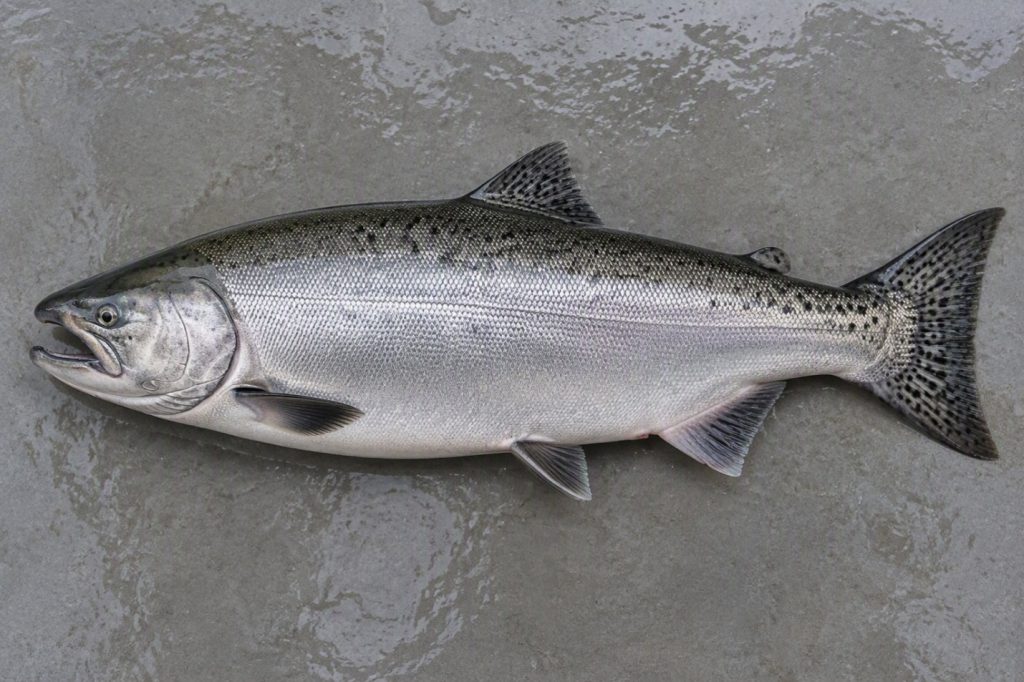
Chinook with an adipose fin.
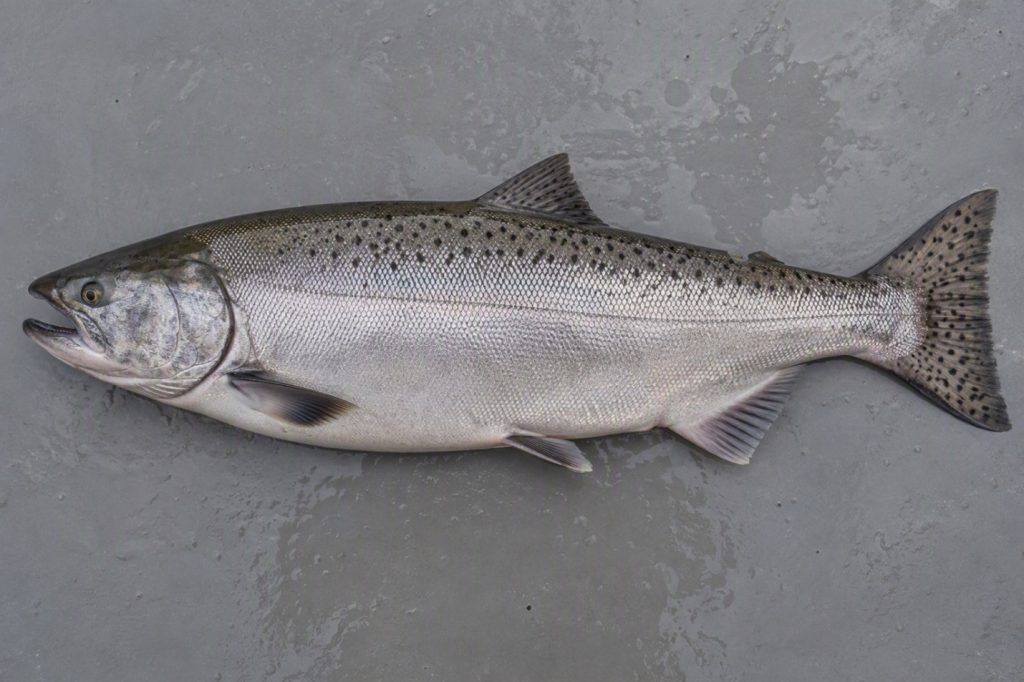
Chinook with a clipped adipose fin.