By Whehs-Wiss-Sunup, Jared Dick, Central Region Biologist
The 1999 Salmon Allocation Policy (SAP), currently under review, was created by Fisheries and Oceans (DFO) to guide how salmon are shared among fishing sectors.
The policy was intended to provide fairness and certainty by setting clear priorities for allocation. It does not assign fixed numbers of fish to any sector; instead, it establishes an order of priority that guides allocation decisions when salmon are available for harvest.
The SAP recognizes three fishing sectors: First Nations, recreational and commercial. For all Pacific salmon species, conservation is the first and highest priority. This means the protection of salmon populations comes before any fishing opportunity. Conservation objectives are not meant to be compromised to meet allocation targets.
After conservation needs are met, First Nations Food, Social and Ceremonial (FSC) fisheries, along with treaty obligations, receive the next highest priority. These fisheries are protected under Section 35 of the Canadian constitution. Only after conservation and First Nations FSC and treaty allocations are addressed does the policy consider allocations to other sectors.
The SAP then separates Pacific salmon into twogroups – the first group includes Chinook and coho. For these species, the recreational sector is given the next level of priority after First Nations FSC fisheries, leaving the commercial sector with the lowest priority. While commercial fisheries rank lowest for Chinook and coho, the policy states that commercial harvest may still occur when salmon abundance allows.
The second group includes sockeye, chum, and pink salmon. For these species, the commercial sector has higher priority than the recreational sector, placing recreational fisheries last. However, the SAP also states that predictable and stable recreational fishing opportunities will be provided.
Review of the 1999 SAP was initiated following the 2018 Ahousaht et al. court decision. In that ruling, the British Columbia Court of Appeal found that the recreational sector’s priority access to Chinook and coho under the existing policy unjustifiably infringed the constitutionally protected Aboriginal commercial fishing rights of five Nuu-chah-nulth Nations (Tla-o-qui-aht, Ahousaht, Mowachaht/Muchalaht, Hesquiaht and Ehattesaht/Chinehkint).
In response, then Fisheries Minister Dominic LeBlanc directed DFO to review the policy and work collaboratively with Indigenous groups and other stakeholders to renew and co-develop it. Any modernized SAP would need to properly reflect Indigenous rights-based food and economic fisheries within the allocation framework.

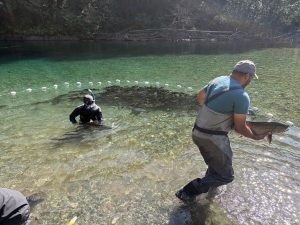
Hishtsatapis Mack of Ehattesaht/Chinehkint First Nation holds up a broodstock chum salmon collected from the Zeballos River in 2024. The nation is attempting to boost the local chum population by producing them at the Zeballos Hatchery.
On December 1, 2025, after several years of engagement, DFO released a discussion paper titled, Perspectives and Recommendations from the Review of the 1999 Allocation Policy for Pacific Salmon in British Columbia.
The 20-page document summarizes areas of agreement and disagreement among sectors. Among the agreements was the need for conservation of salmon to remain top priority, with stronger protections than currently exist. There was also broad agreement that Aboriginal and treaty rights-based food and economic fisheries must have higher priority than the remaining sectors.
This means that rights-based commercial fisheries will receive priority after FSC and treaty domestic needs are addressed for all Pacific salmon species, but before consideration is given to regular commercial and recreational salmon fisheries.
What remains unresolved is how recreational and non-Indigenous commercial fisheries should be prioritized after First Nations rights-based fisheries. Despite this, some interest groups have spread misinformation claiming that First Nations are seeking to shut down the recreational fishery.
This is false. The SAP review is not about eliminating any fishery, it is about how a limited and declining resource will be shared in a way that is consistent with the law.
“Canada must bring policy in line with the law and protect salmon for all who depend on them,” said Cloy-e-iis, Judith Sayers, Nuu-chah-nulth Tribal Council President, in a February 3 media release.
Many Indigenous organizations, including the Nuu-chah-nulth Tribal Council and British Columbia Assembly of First Nations, have called on DFO to condemn the racist and inflammatory rhetoric that currently surrounds the SAP review and to refocus the discussion on facts, rights and conservation.
“Our nations have relied on salmon for thousands of years, and our rights and responsibilities to these
waters are not up for debate,” added Sayers.